 Therapeutic
Intranasal Drug Delivery
Therapeutic
Intranasal Drug DeliveryIntranasal Midazolam protocol for treating acute seizures:
Indications: For treatment of persistent seizure activity
Procedure:
- Assess ABC’s – Airway, Breathing, Circulation
- For pulseless patients, proceed to ACLS guidelines
- Apply 100% oxygen NRB mask to seizing patient
- Use age based table to determine proper volume of midazolam for atomization (see table below)
- To calculate it manually, use the below
formula
-
Assess
weight: children weight in kg = 10 + 2(Age in years)
-
Calculate appropriate dose of midazolam using the following
formula:
-
Children: Total kg wt X 0.2 mg = total mg dose of midazolam,
maximum of 10 mg
-
Adults over 50 kg: 10 mg (2 ml) of midazolam
- Total volume in milliliters of midazolam (5mg/ml concentration) = (Total mg dose divided by 5mg/ml) + 0.1 ml for dead space of device.
-
Children: Total kg wt X 0.2 mg = total mg dose of midazolam,
maximum of 10 mg
-
Assess
weight: children weight in kg = 10 + 2(Age in years)
- (If using lorazepam - 0.1 mg/kg to max 4 mg)
- Load syringe with appropriate milliliter volume of midazolam (use only 5mg/ml concentration) and attach nasal atomizer
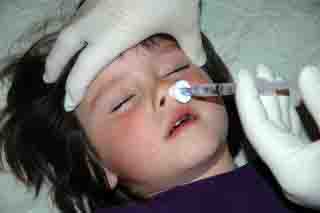
- Place atomizer within the nostril
- Briskly compress syringe to administer 1/2 of the volume as atomized spray.
- Remove and repeat in other nostril, so all the medication is administered
- Continue ventilating patient as needed
If seizures persist 5 minutes after treating, consider repeating ½ dose of midazolam either intranasally, intramuscularly or intravenously. Secure airway if necessary.
Midazolam Dosing chart
|
Patient age
(years) |
Weight
(kg) |
IN Midazolam volume in ml*
5mg/ml concentration Volume Dose (mg) |
|
Neonate |
3
kg |
0.3 ml
0.6 mg |
|
<1 yr |
6
kg |
0.4 ml
1.2 mg |
|
1 yr |
10 kg |
0.5ml
2.0 mg |
|
2 yr |
14 kg |
0.7 ml
2.8 mg |
|
3 yr |
16 kg |
0.8 ml
3.2 mg |
|
4 yr |
18 kg |
0.9 ml
3.6 mg |
|
5 yr |
20 kg |
1.0 ml
4.0 mg |
|
6 yr |
22 kg |
1.0 ml
4.4 mg |
|
7 yr |
24 kg |
1.1 ml
4.8 mg |
|
8 yr |
26 kg |
1.2 ml
5.2 mg |
|
9 yr |
28 kg |
1.3 ml
5.6 mg |
|
10 yr |
30 kg |
1.4 ml
6.0 mg |
|
11 yr |
32 kg |
1.4 ml
6.4 mg |
|
12 yr |
34 kg |
1.5 ml
6.8 mg |
|
Small teenager |
40 kg |
1.8 ml
8.0 mg |
|
Adult or full-grown teenager |
> 50 kg |
2.0 ml
10.0 mg |
* This volume is based on the calculated dose PLUS 0.10 ml dead space in the device (the amount of medication that will remain within the syringe and atomizer tip and therefore will not be delivered to the child). The total volume is then rounded off to the next highest 0.1 ml. Slightly higher doses may be appropriate at the lower range of volume (in smaller children) due to measurement difficulties and possible under dosing which may not stop the seizure.
In some children a higher dose (0.3 mg/kg) may be more appropriate
Home Therapy directions for Intranasal midazolam during an acute seizure (Click Here)
Download a basic photographic display of how to draw up and administer intranasal midazolam for seizures or sedation (click here for MS word document 0.53 MB)
Download IN midazolam for seizures abridged photo guide as PDF file (click here)